Sussex, Surrey & Kent · 8 min read
Landscaping Ideas for Small Gardens: Making a Narrow Plot Feel Twice the Size
Courtyards, side returns and narrow town plots reward a different set of moves to a big garden. Here are the ones that consistently work.
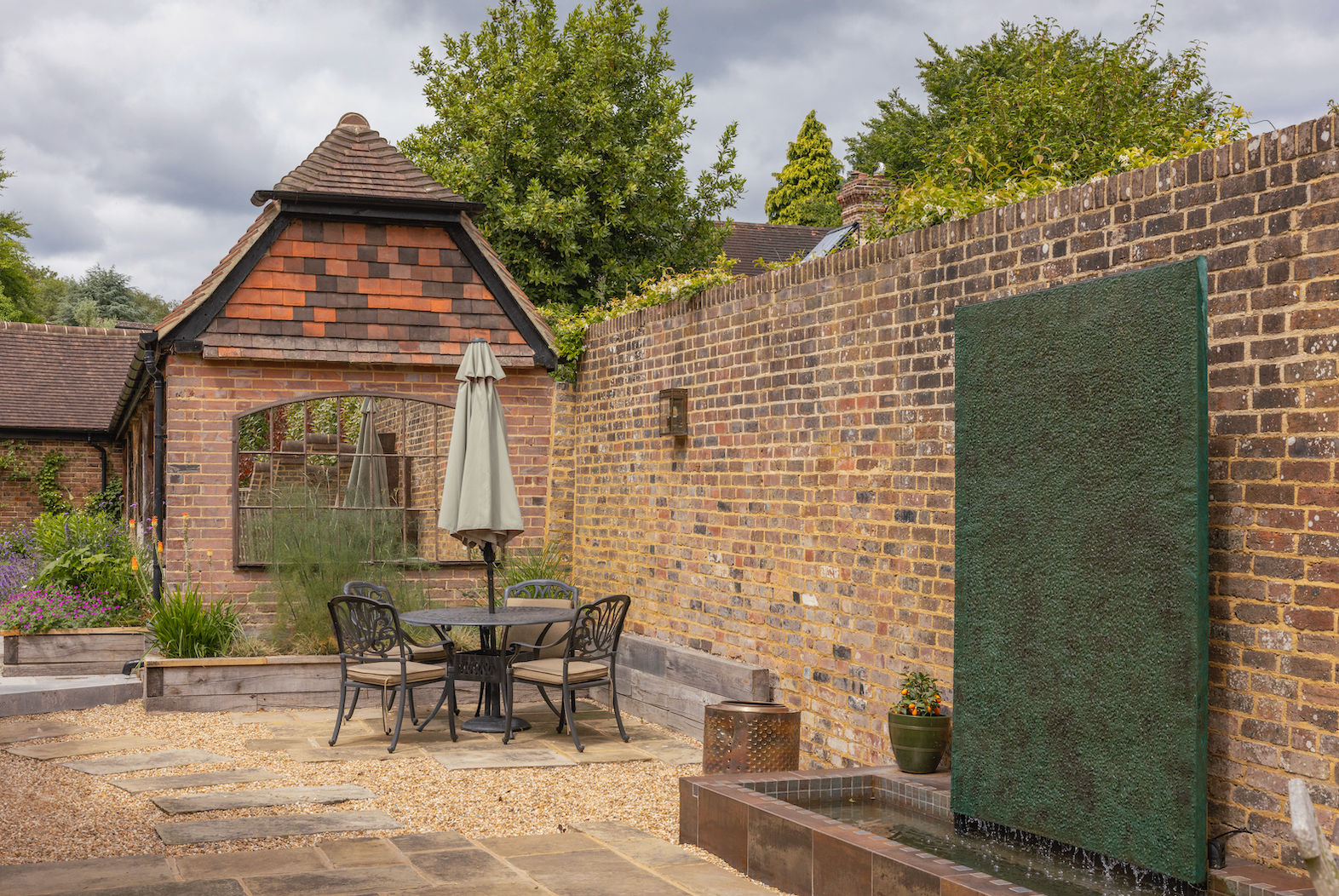
A small walled courtyard in Mid Sussex: one continuous paving material, built-in seating and planting held to the boundaries.
Small gardens are harder to design than large ones. There is nowhere to hide a mistake, every material is seen from a metre away, and a single oversized feature can eat the whole plot. The good news is that the moves that make a small garden work are well established, and most of them cost less than the clutter they replace.
Start by taking things out, not adding them
Almost every small garden we are asked to rescue has too many separate elements in it: a shed, a bin store, a rotary line, three sizes of paving, a raised bed, a few pots and a strip of tired lawn. Each was reasonable on its own, and together they chop the space into fragments. The first design decision is usually subtraction - one paving material, one boundary treatment, one place for storage, and everything else planted.
Use one paving material and lay it the long way
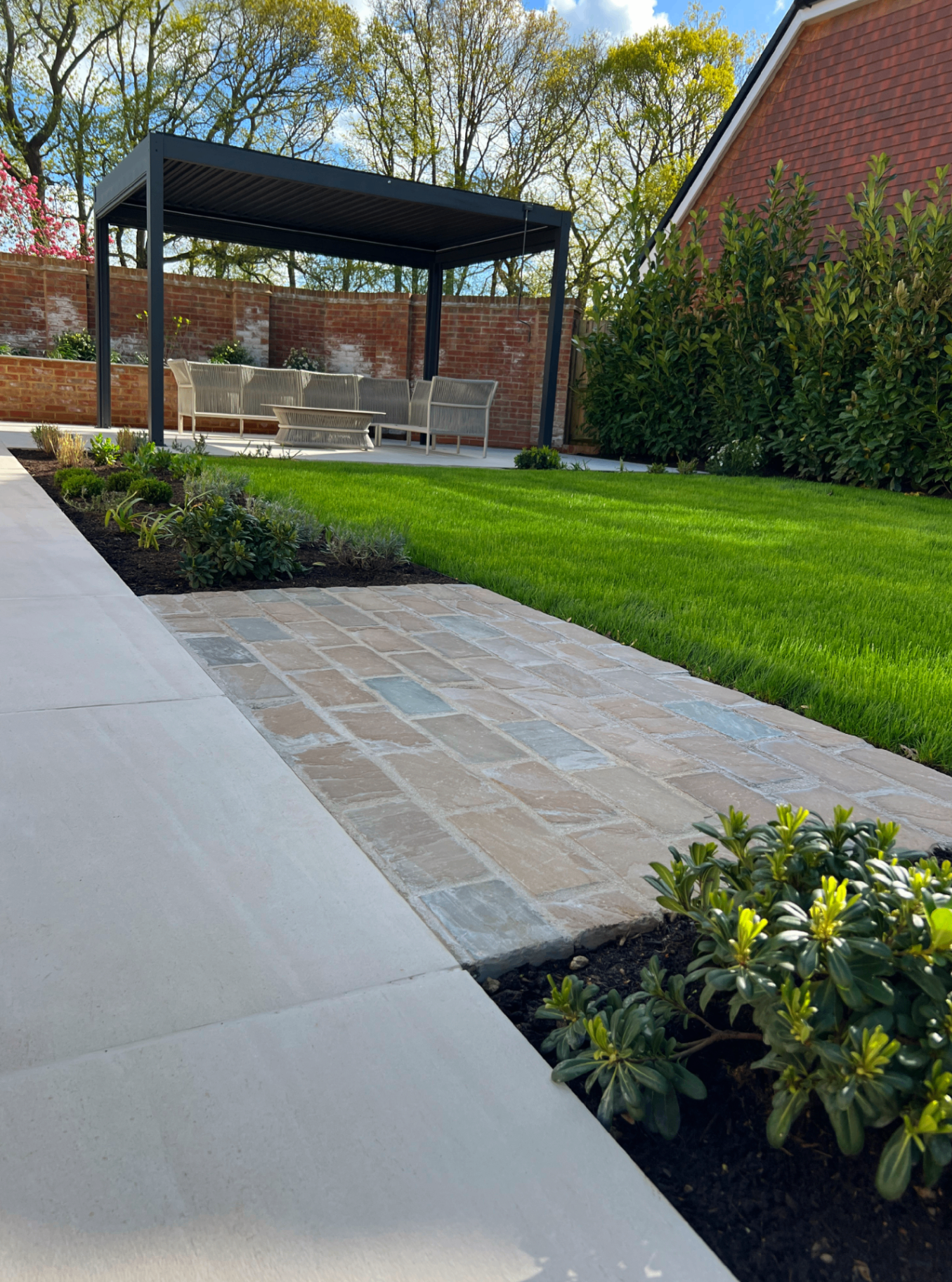
Large-format paving in a single tone makes a small garden read as one surface rather than a mosaic. Laying the long edge of the slabs away from the house draws the eye down the plot, and matching the tone to your interior floor blurs the threshold so that the room and the garden feel like one space. On a narrow side return, running the paving across the width instead can do the opposite job and widen it.
Build the seating in
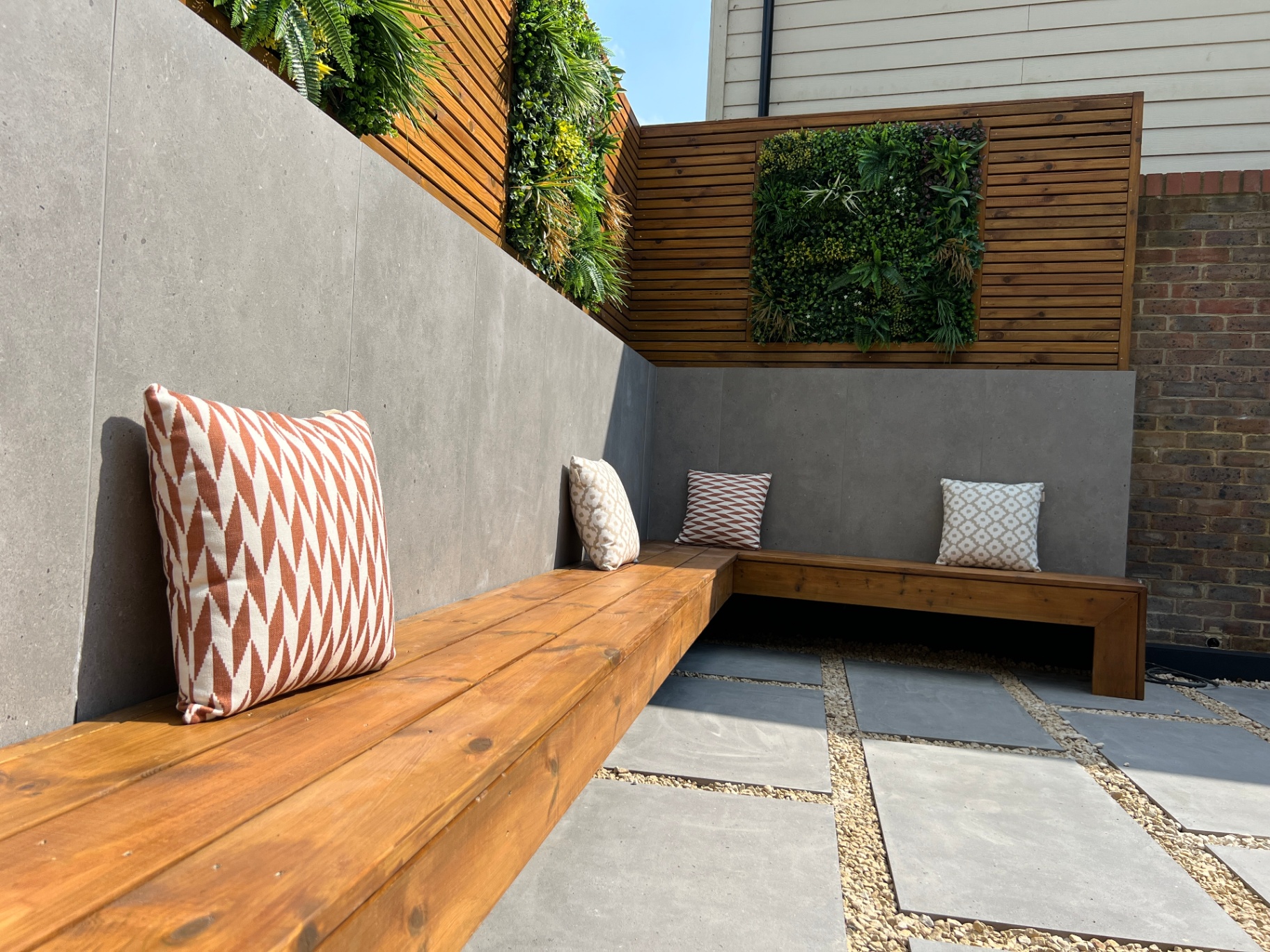
Freestanding furniture is the biggest thief of space in a small garden. A six-seat table and chairs needs circulation space on all four sides. Built-in benches along a boundary need none - they use the wall you already have, they double as retaining or as storage, and they leave the middle of the plot free. A bench, a low table and a fire bowl will seat more people in less space than a dining set ever will.
Change the level, even slightly
A 300mm step down into a sunken seating area, or a raised planted platform at the far end, does two things at once: it gives the eye somewhere to travel to, and it creates a sense of a second room. On the Weald clay of Mid Sussex a level change also gives you somewhere useful to move spoil to instead of paying to cart it away.
Plant vertically and hold the middle clear
- Multi-stem trees such as amelanchier or birch give height and dappled shade without a heavy canopy.
- Climbers on wires against a fence give you a green boundary with almost no ground footprint.
- Deep borders on two sides beat shallow borders on four - depth is what makes planting look intentional.
- Evergreen structure at 30 to 40 per cent keeps the garden from emptying out in February.
- Pleached or espaliered trees screen an overlooking window at first-floor level without shading the whole plot.
Screen the neighbours, not the sky
Overlooking is the most common complaint in a small town garden, and the usual response - a taller fence - makes the space feel like a box. Screening at eye level where you actually sit, using a pergola beam, a slatted panel or a pleached hedge, blocks the view that bothers you while leaving the sky open. It is also far more likely to keep the neighbours friendly.
Lighting is the cheapest way to double the space
A small garden is seen from indoors for most of the year. Without lighting, the window is a black mirror after four o'clock in winter and the garden ceases to exist. With warm, low-level lighting - a wash up a wall, an uplight into a tree, a strip under a bench - the space is still visible from the kitchen and the room feels larger for it. Run the cabling while the ground is open; it costs very little then and a great deal later.
Where storage goes
Bins, bikes and tools do not disappear because a garden is small. Designing a single joinery run in the same timber and tone as the rest of the garden - bin store, tool store and a bench top over it - is almost always neater and cheaper than buying three separate plastic boxes and then working around them.
What it costs
A small garden is not a cheap garden per square metre. Access is usually worse, everything is hand-barrowed, and the detailing is seen close up so it has to be right. What it is, is a smaller total - a compact courtyard rebuild is a fraction of the cost of a full estate garden, and because it is used every single day it is often the best-value work we do.
Small gardens across Sussex, Surrey and Kent
We build compact gardens throughout Mid Sussex - Haywards Heath, Cuckfield, Lindfield, Burgess Hill - as well as the Brighton and Lewes terraces, Horsham and Crawley town plots, and across Surrey in Guildford, Godalming and Reigate. Different ground, same principles: get the levels and drainage right first, then keep the surface simple.
Common questions
- How do you make a small garden look bigger?
- Keep the paving in one material, run lines across the width rather than down the length, hide the back boundary with layered planting, and use one strong focal point instead of several small ones. Fewer, larger elements always read bigger than many small ones.
Related services
Where we work
We design and build gardens, garden rooms and pergolas across Mid Sussex and the surrounding towns.
More garden design guides
- Garden Design in Cuckfield: What a Bespoke Design Process Actually InvolvesFrom the first site survey to the finished build, here is exactly how a bespoke garden design unfolds for a Cuckfield home - and what to expect at each stage.
- Luxury Garden Design in Haywards Heath: Costs, Timelines and What to ExpectA frank guide to budgets and programme for a high-end garden in Haywards Heath - what drives cost, what protects value, and where to spend first.
- Sloping Gardens in the South Downs: Terracing, Steps and Retaining WallsA slope is an opportunity to build a garden with rooms, views and drama - provided the engineering underneath it is taken seriously.