Sussex · 9 min read
Garden Room Cladding: Every Option Compared, With Real Costs
The cladding is the first thing anyone sees and the first thing to fail if it is specified badly. Here is how the main options compare on cost, movement, colour and maintenance.
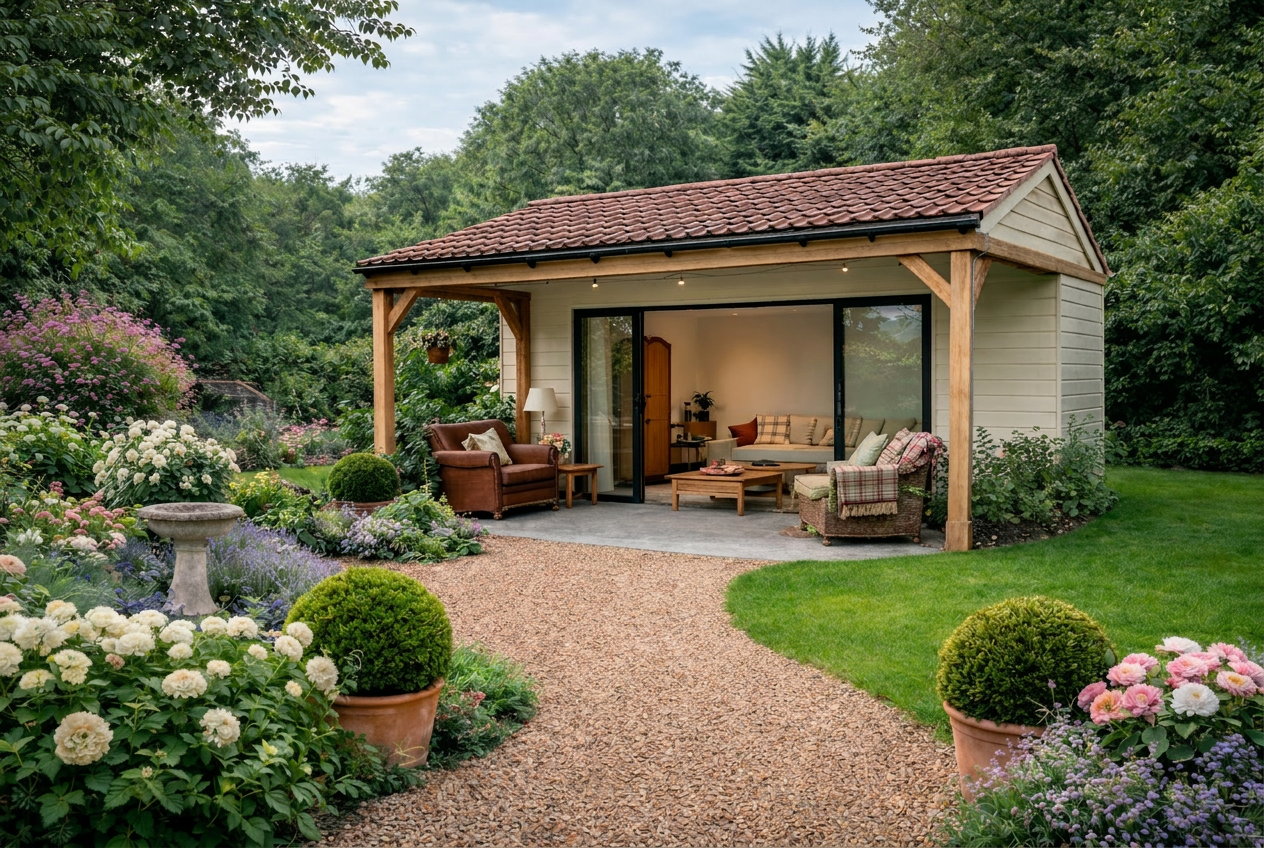
Timber-clad garden room with vertical Siberian larch cladding in a Sussex garden
Cladding decides how a garden room looks on day one and how it looks in year ten. It also decides how much attention it needs in between. The choice is rarely about appearance alone - movement, weathering, fire performance near a boundary and the build-up behind the boards all matter more than the sample you held in a showroom.
This is the comparison we walk clients through before any garden office or garden room in Sussex goes on the drawing board, with the costs, trade-offs and detailing that decide whether a cladding choice ages well.
Siberian larch
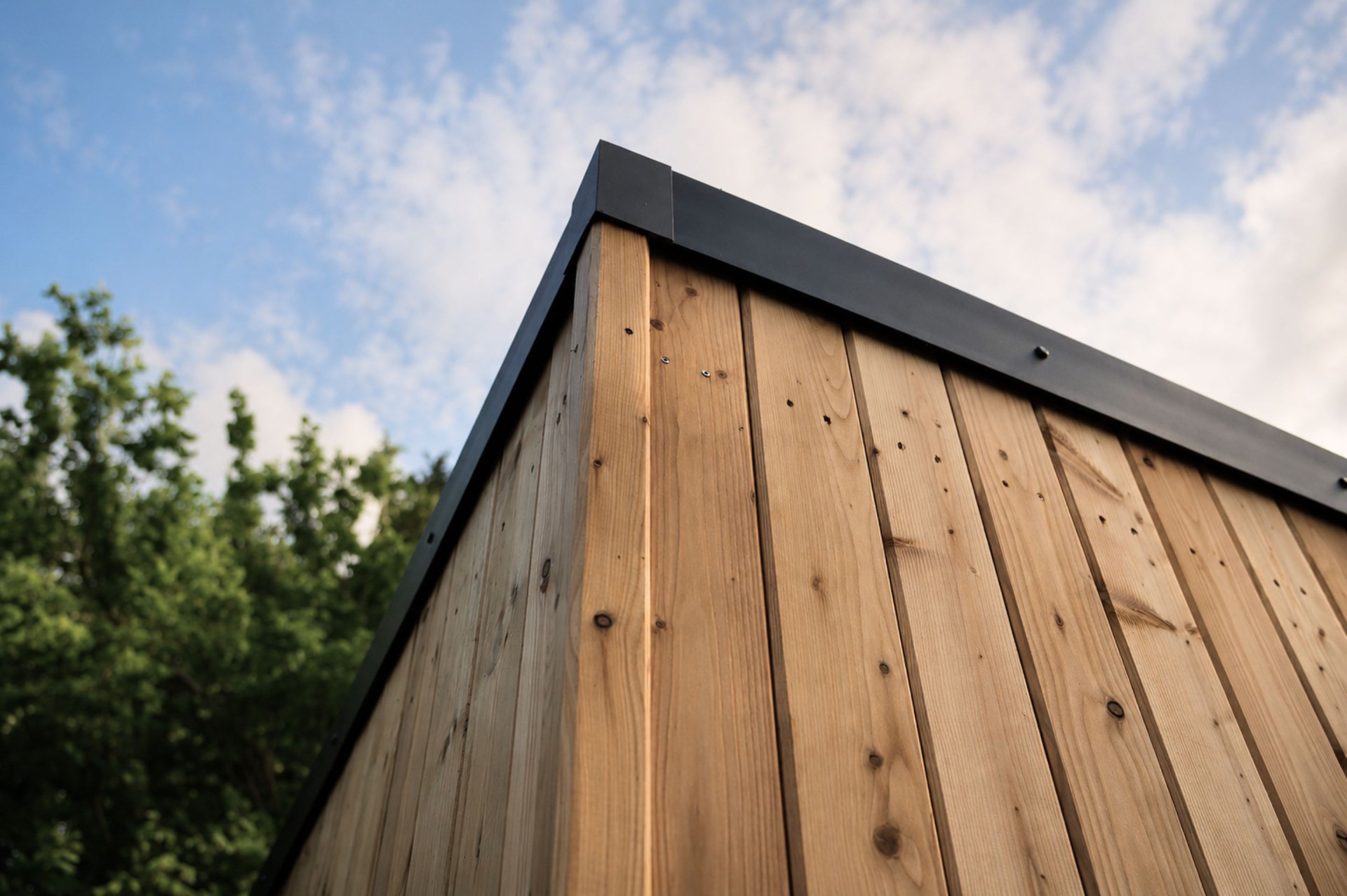
Siberian larch is the workhorse of modern garden rooms, and for good reason. It is a slow-grown softwood with tight grain, naturally durable heartwood and a straight, contemporary look, usually specified as an open-jointed rainscreen. Expect roughly £45-£75 per square metre supply and fit for a standard profile, rising for wide boards or a shadow-gap detail. Left unfinished it silvers evenly to a soft grey within twelve to eighteen months; oiled annually it holds its honey-brown colour. It moves seasonally with humidity, which is why boards are fixed with a gap and never glued tight to a frame.
Western red cedar
Cedar costs more - typically £65-£100 per square metre - for a warmer colour and a slightly softer, more tactile board. It contains natural oils that give it excellent rot resistance without treatment, but those same oils can bleed and stain adjacent render or paving if run-off is not managed, and cedar is softer than larch so it marks more easily in high-traffic areas like door reveals. We cover the direct comparison in detail in our cedar versus larch guide.
Thermally modified timber
Thermally modified ash, ayous or ash-like species are heated under controlled conditions rather than chemically treated, which changes the cell structure so the timber absorbs less moisture and moves less. It carries a durability rating equivalent to naturally durable hardwoods without the cost of a genuine hardwood. Expect £70-£110 per square metre. It silvers faster and more uniformly than larch, which some clients prefer because the colour change is predictable and even across every elevation.
Charred timber and shou sugi ban
Charring the surface of the board - the Japanese technique known as shou sugi ban, usually applied to cedar or larch - creates a carbonised layer that resists rot, insects and UV fading. The finish is a deep black or dark brown that barely changes over time, which is its main appeal against a lighter house or planting. Factory-charred and sealed boards run £90-£140 per square metre. Site-applied flame treatments exist but are inconsistent and we do not specify them; the controlled factory process is what actually delivers the durability claims.
Composite cladding
Composite boards, typically a wood-fibre and recycled polymer blend, cost £60-£95 per square metre and need no oiling, sanding or replacement of individual boards for movement or rot. The trade-off is a slightly plastic hand-feel up close and a colour range that reads flatter than real timber in direct light. It suits clients who want the timber look with genuinely zero maintenance, particularly on a second home or a room that will not be visited weekly.
Corrugated and standing-seam metal
Powder-coated steel or aluminium in corrugated or standing-seam profiles gives a crisp, architectural look that reads well against contemporary glazing. Cost sits at £80-£130 per square metre depending on gauge and finish. Metal does not move with moisture, needs no maintenance beyond an occasional wash, and its main drawbacks are noise in heavy rain unless the roof build-up is properly insulated behind it, and a colder, more industrial character that does not suit every garden.
Fibre cement cladding
Fibre cement boards or panels give a render-like or board-marked finish that is completely inert - no rot, no insect attack, minimal movement - for £70-£100 per square metre. It is heavier than timber or composite, which affects the frame design, and cut edges need sealing during installation. We specify it where a client wants a rendered look without the maintenance and cracking risk of true render.
The build-up behind the cladding matters as much as the board
- A ventilated cavity of at least 25mm behind the cladding lets moisture that gets past the boards escape rather than sit against the frame.
- A breather membrane on the frame side of the cavity stops driven rain reaching the structural timber while still letting vapour out.
- Stainless steel fixings, not galvanised, avoid staining and premature corrosion, particularly with cedar's natural acids.
- Board width and fixing gap need to allow for seasonal movement - tight-fixed timber cups, splits or pops its fixings within a couple of years.
- Fire performance and cladding choice both tighten up if the building sits close to a boundary; check with your designer before committing to a finish.
Maintenance, honestly
Untreated larch, cedar and thermally modified timber all need nothing beyond an annual check of fixings and gutters if you are happy for them to silver naturally. If you want to hold the original colour, budget for re-oiling every twelve to twenty-four months depending on aspect - south and west elevations weather fastest. Charred timber, composite, metal and fibre cement all need essentially no upkeep beyond a wash. Factor this into the decision alongside the upfront cost per square metre, because the cheapest board to buy is not always the cheapest to own.
What we specify and why
For most garden offices and garden rooms across Sussex we default to Siberian larch on a ventilated cavity, because it balances cost, appearance and a weathering pattern clients understand in advance. We move to cedar where a warmer tone is wanted against a period house, to charred timber where a bold, dark elevation is the brief, and to composite or metal where the building will get limited attention and zero maintenance genuinely matters more than the material story.
Where we work
We design and build gardens, garden rooms and pergolas across Mid Sussex and the surrounding towns.
More materials & build guides
- Choosing Paving and Natural Stone for a Sussex GardenPaving is the largest single surface in most gardens and the easiest to get wrong. A practical guide to stone selection for Sussex homes.
- Year-Round Planting Schemes for West Sussex GardensMost gardens peak for six weeks and disappear for the rest of the year. Structure, succession and the right soil match fix that.
- Porcelain vs Natural Stone Paving: An Honest ComparisonBoth are excellent. They fail in different ways and suit different houses - here is how we choose between them.